Everything your care team needs. Nothing they do not.
CareStream is purpose-built for UK care settings. Every feature addresses a real challenge that registered managers, HR leads, and frontline staff face every day.
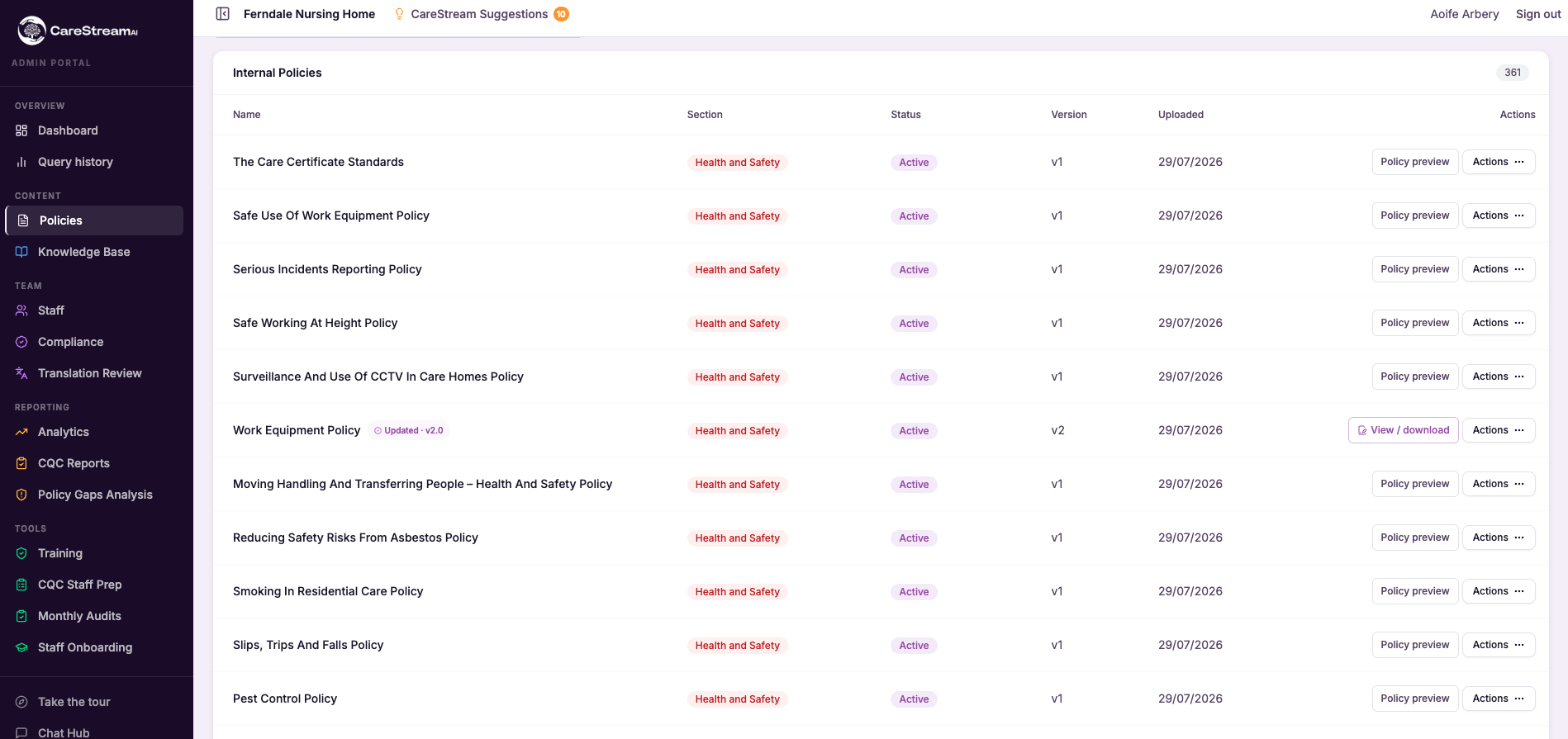
Ask in the hub, or by email. One consistent answer.
Both draw from the same policy library and give the same quality of answer. Staff use whichever fits their situation, and every interaction lands in the same audit trail.
A full conversational interface in any browser, and installable as an app on staff phones. Staff sign in once with a one-tap link, then ask questions by typing or speaking, with full context kept for the whole conversation.
Web and installable app
- Type or speak your question, and hear the answer read back
- Full session context maintained across multiple questions
- Suggested follow-up questions after every response
- Installs like an app on any phone, with a passwordless sign-in link
- Answers in over 60 languages, in the language you ask
Staff email your dedicated CareStream address from any device. The reply arrives in the same thread, and replying to it continues the conversation with full context kept across every exchange.
Any email client, any device
- No app and no sign-in required to use
- Response delivered into the same email thread
- Reply to ask a follow-up question at any time
- Works from any email app on any device
- Ideal during shift handover or when away from the home
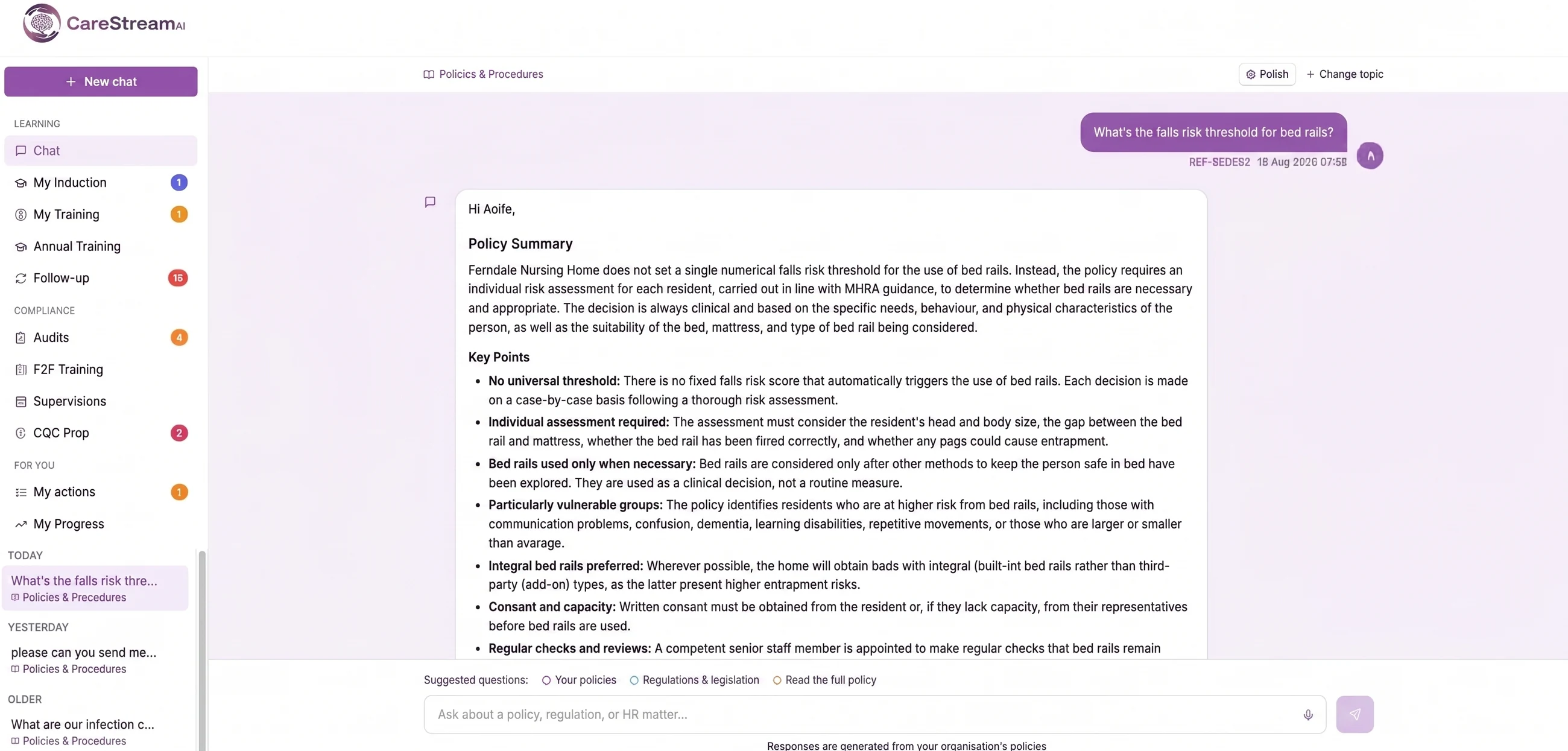
60+ languages. Zero configuration.
Language detection is automatic on every query. Staff do not select a language, toggle a setting, or use any special command. They ask their question in the language they think in, and the answer arrives in the same language.
Your policies remain in English. Translation happens at the point of response, not at the point of upload. One authoritative English policy library, consistently available in every language your workforce uses.
- The same question, six languages, one policy
- All answered from the same Falls Policy, each in the language asked
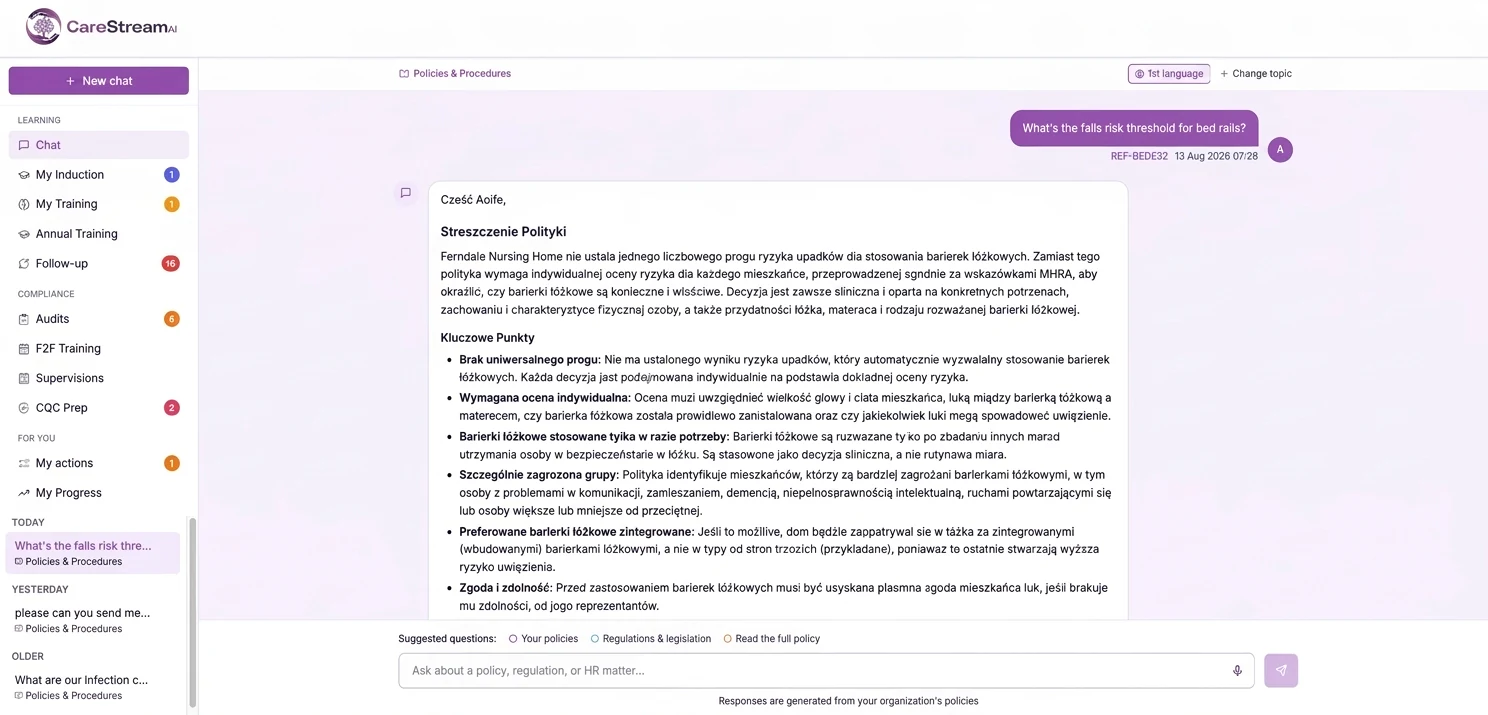
A policy library that works as hard as you do.
Upload once and CareStream handles the rest. Documents are automatically processed, indexed, and made searchable within minutes of upload with no manual work required.
Upload any combination of file formats. CareStream reads and indexes all common document types with no conversion or reformatting needed from you.
Documents are processed and indexed automatically. Staff can query a newly uploaded policy within minutes of it being added to the library.
Page numbers, version stamps, document headers and footers are removed automatically. The AI reads only the substantive policy content.
Each document is broken into meaningful sections and indexed for semantic search. Answers are retrieved even when the wording of the question differs from the policy.
Upload a revised policy and the old version is retired from the retrieval system automatically. The full version history is retained for post-incident review.
Set a review interval for each policy and CareStream will remind you when it is due. Your library stays current without any manual tracking.
Upload your staff handbook alongside your clinical policies. Large handbooks are indexed chapter by chapter, so staff get accurate answers about annual leave, disciplinary procedures, pay and onboarding from the right part of the document.
Organise your library by category, department, or regulatory framework. Makes browsing and reporting easier for managers and auditors.
Every answer names the policy and the version it came from, so staff can check the exact source and you can trust what was said.
UK regulation, alongside your own policies.
Your internal policies are built on UK law and regulation. CareStream keeps the UK regulations that matter to care services loaded and up to date, so when a staff member asks something that touches both your policy and an external requirement, the response explains how the two interact.
The most relevant section of your own policy is found and used as the primary source for the response.
CareStream identifies which of the loaded frameworks apply to the question and adds that regulatory context to the response.
The response covers what your policy requires and what the law requires, and explains where they align, where they differ, and where your policy goes further.
Reg 9 to 20
HSWA 1974
UK GDPR
MCA 2005
Care Act 2014
RIDDOR 2013
EA 2010
COSHH 2002
- How it works
- A selection of included frameworks
- Plus more, kept up to date as regulations change
Not generic answers. Your home’s answers.
CareStream answers from the actual content of your own policies. When a policy names a person, a schedule, or an exact local procedure, that is what staff get back, not a generic restatement.
Managers can also add knowledge entries directly, capturing the operational detail that lives in practice, named leads, local procedures, and out-of-hours contacts, and approving it so it is available to everyone in the same answers.
"The designated infection control lead as named in the policy."
Who is responsible for infection control?
"Maria Chen is the Infection Control Lead. On nights and weekends, cover is provided by the senior carer on shift."
"According to the cleaning schedule in the Infection Control Policy."
How often is the sluice room deep-cleaned?
"The sluice room is deep-cleaned every Monday and Thursday morning. The daily clean is recorded on the log inside the door."
"Follow the colour-coding scheme set out in the Infection Control Policy."
What colour mop for the bathrooms?
"Blue mops for bathrooms and toilets. Yellow for kitchen areas. Red for high-risk areas only."
"Contact the on-call manager per the Medication Policy."
Who do I call for a medication issue overnight?
"Call Sarah Ambridge on the duty manager number. The out-of-hours number is posted inside the medication room door."
- Staff asks
- Generic policy answer
- CareStream answer
Find your gaps before CQC does.
Every time CareStream cannot find an answer in your documents, it flags the query as a gap. Over time, patterns emerge: the same questions appearing repeatedly without any policy coverage.
Your Policy Gap Report shows exactly which questions your staff are asking that your current policies do not address, ranked by frequency. This is actionable evidence of where your library needs strengthening, surfaced before an inspection identifies it first.
Every unanswered query is flagged immediately rather than batched for a monthly report.
The most commonly asked unanswered questions appear first, so you address the most impactful gaps first.
The gap report is kept current and ready for your manager review cycle, with nothing to compile by hand.
Gap identification and resolution is included in your CQC Readiness Report as proof of continuous improvement.
Your compliance evidence builds automatically.
Every interaction with CareStream is logged and structured. Your analytics dashboard and CQC Readiness Report are generated from this data continuously, with nothing to compile manually.
- Total queries and trend over time
- Queries by channel (hub, email, voice)
- Most requested policies this month
- Active staff members this month
- Plan usage vs allowance
- Policy not found rate
- Policy last updated date
- Language breakdown across all queries
- Knowledge gap detection report
- Query trend analysis over 12 months
- Staff engagement by individual
- CQC Readiness Report PDF
- Analytics feature
- Starter
- Professional
- Not included
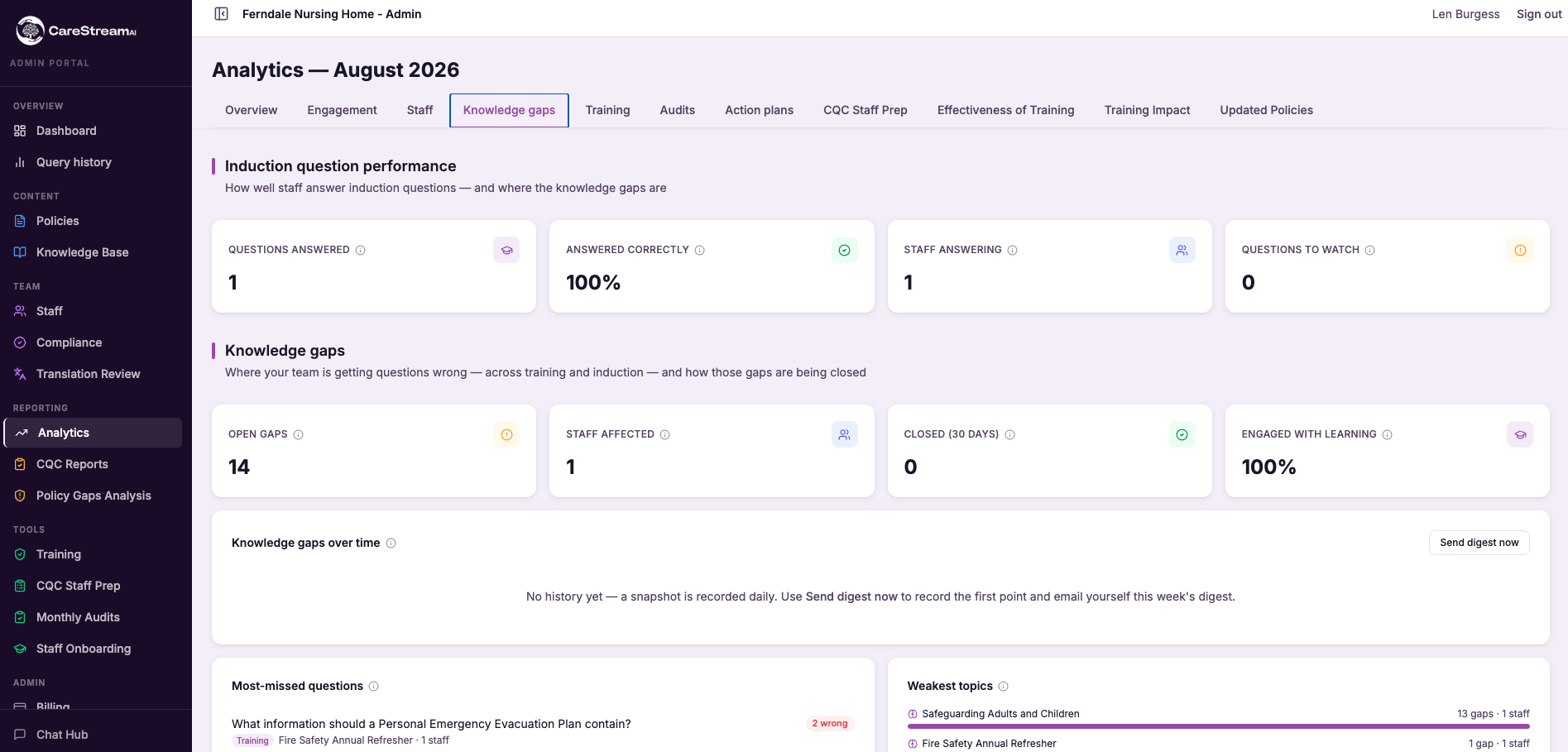
Your data stays yours.
Every tenant’s policy library is stored in a completely isolated environment. Your policies are never used to train any model, never shared with other organisations, and never accessible to anyone outside your account. Data is encrypted at rest and in transit. UK data residency is available on Professional and Enterprise plans.
Complete data separation between all organisations
Only vetted, approved content is ever served to staff
Your documents are never used to train AI models
Available on Professional and Enterprise plans
See Care Policies against your own policies
Digital policy management and distribution. Upload what you already have and see it working inside a fortnight.
How these are written
Your policy, not a template with your name dropped into it.
Most policy packs are one document sold to everyone, with a find and replace on the home name. These are built the other way round. We start from the legislation, then we ask you about your own service, and the policy is written from your answers.
Your registered name, address, CQC numbers and who holds the key roles. About three minutes. Nothing else is asked before you pay.
Do you use electronic care records or paper. Who leads on infection control. Which pharmacy supplies you. What your evacuation strategy is. Asked once, in your own account, and used across every policy you own.
Where you have told us something, the policy states it as fact. Where you have not, it says what must happen rather than claiming it already does. It never guesses which way the answer goes.
Every required element of every piece of legislation behind the policy is checked off, and a person reads it before it reaches you.
We assess our premises and equipment annually and hold a stock of easy read and large print documents.If you do not do this, you have just handed an inspector a signed statement saying you do. A policy that overclaims is worse than one that leaves a gap.
The registered manager will ensure an accessibility assessment is carried out each year, and will hold accessible formats appropriate to residents’ recorded needs.An obligation you can meet and evidence, until you tell us what you already have, at which point it says that instead.
The policy library
All 66 policies, written for your service.
Buy a single policy or a pack. Each one is written for the organisation buying it, structured from the legislation itself, read by a person before it carries your name, and kept updated when the law changes.

Recognising, responding to and reporting abuse and neglect, aligned to the Care Act 2014 and your local authority procedures.

Ordering, storage, administration, recording and disposal of medicines, including errors and self-administration.

Capacity assessment, best-interests decisions and deprivation of liberty safeguards under the MCA 2005.

Your general statement, organisation and arrangements under the Health and Safety at Work etc. Act 1974.

IPC arrangements aligned to the Code of Practice, including audit and cleaning schedules.

Lawful handling of personal and special category data under UK GDPR and the Data Protection Act 2018.
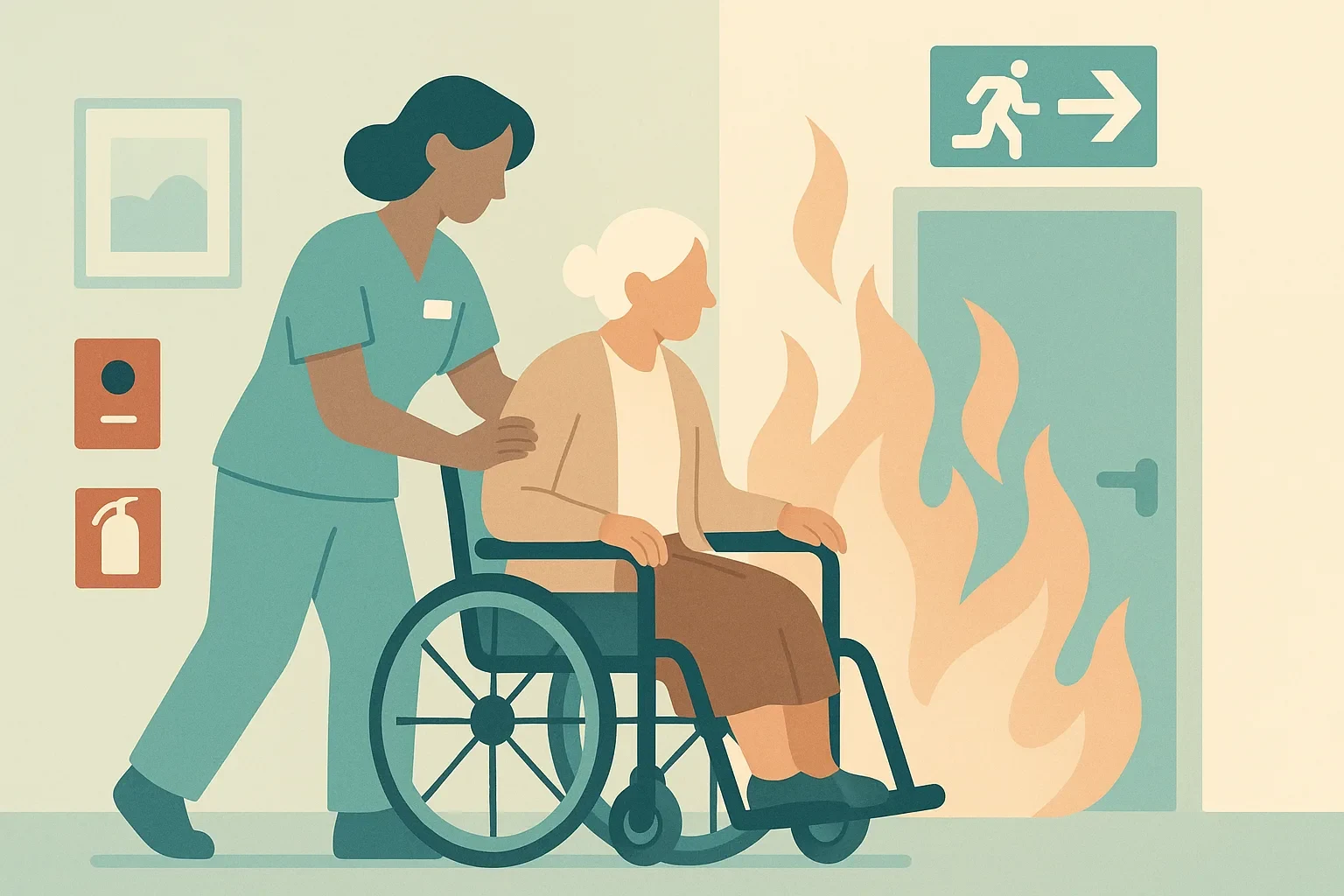
Prevention, detection, evacuation (including PEEPs) and staff responsibilities under the Fire Safety Order 2005.

Receiving, investigating and learning from complaints under Regulation 16, including LGSCO signposting.

Being open and honest when things go wrong, under Regulation 20.

Seeking, recording and reviewing consent, including where capacity fluctuates.

Fit and proper persons, DBS checks, references and ongoing suitability under Regulation 19.

Raising concerns safely, PIDA protections, and your speak-up arrangements.

Safe moving and handling of people and loads, training and equipment under LOLER and MHOR.

Recording, investigating and learning from incidents, RIDDOR and CQC notifications.

Receipt, storage, administration, recording and destruction of controlled drugs.

Person-centred assessment, planning, review and involvement under Regulations 9 and 12.

Advance care planning, symptom management, dignity in dying and support for families.

Understanding behaviour as communication, proactive support and reducing restrictive practice.

When restriction is lawful, proportionate and recorded, and how it is reduced.

Duties for people subject to the MHA 1983, including section 117 aftercare, guardianship and detention interfaces.
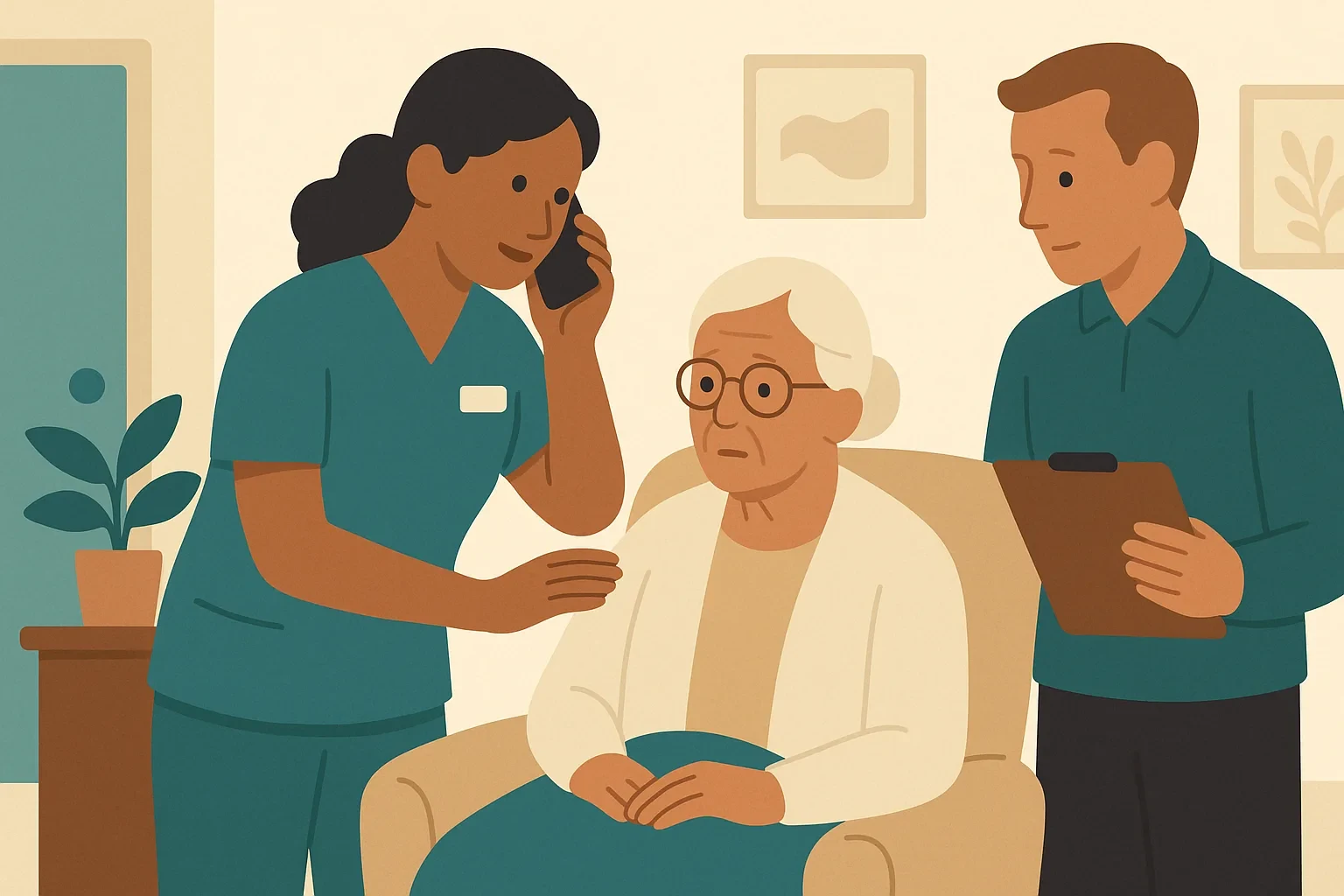
Recognising, containing and reporting infectious outbreaks with your escalation contacts.

The Regulation 12 umbrella: risk assessment, safe premises, medicines and infection prevention brought together.

How clinical quality is led, measured, audited and improved.

Fair, ACAS-aligned disciplinary and grievance procedures.

Your registered Statement of Purpose under the 2009 Registration Regulations, ready to file with CQC.

Treating people with dignity, respect and privacy under Regulation 10.

Meeting the Equality Act 2010 and human rights obligations in care delivery and employment.

Meeting nutrition and hydration needs under Regulation 14, including screening and fortified diets.

Food hygiene, allergen management and Natasha’s Law compliance.

Keeping personal information confidential, and when sharing is right.

Keeping people safe through outages, staffing crises and emergencies, with your escalation contacts.

Pre-admission and ongoing needs assessment feeding directly into care plans.

Care built around each person’s preferences, strengths and goals under Regulation 9.

The Caldicott principles applied to your service, and who decides when data is shared.

Creating, storing, retaining and destroying records, aligned to the Records Management Code.

The framework over your data policies: accountability, training, breaches and DSPT alignment.

Which events must be notified to CQC, by whom, and how fast.

Your audit calendar, how findings become actions, and how improvement is evidenced under Regulation 17.

Identifying, assessing, recording and reviewing risk across care and operations.

How the service is directed and held to account: leadership, oversight and reporting lines.

Directors and managers meeting Regulation 5, at appointment and continuously.

Regular supervision and annual appraisal under Regulation 18, with frequencies and records.

Induction, mandatory training and refreshers, mapped to the Care Certificate.

Safe staffing levels, skill mix, dependency review and rota management.
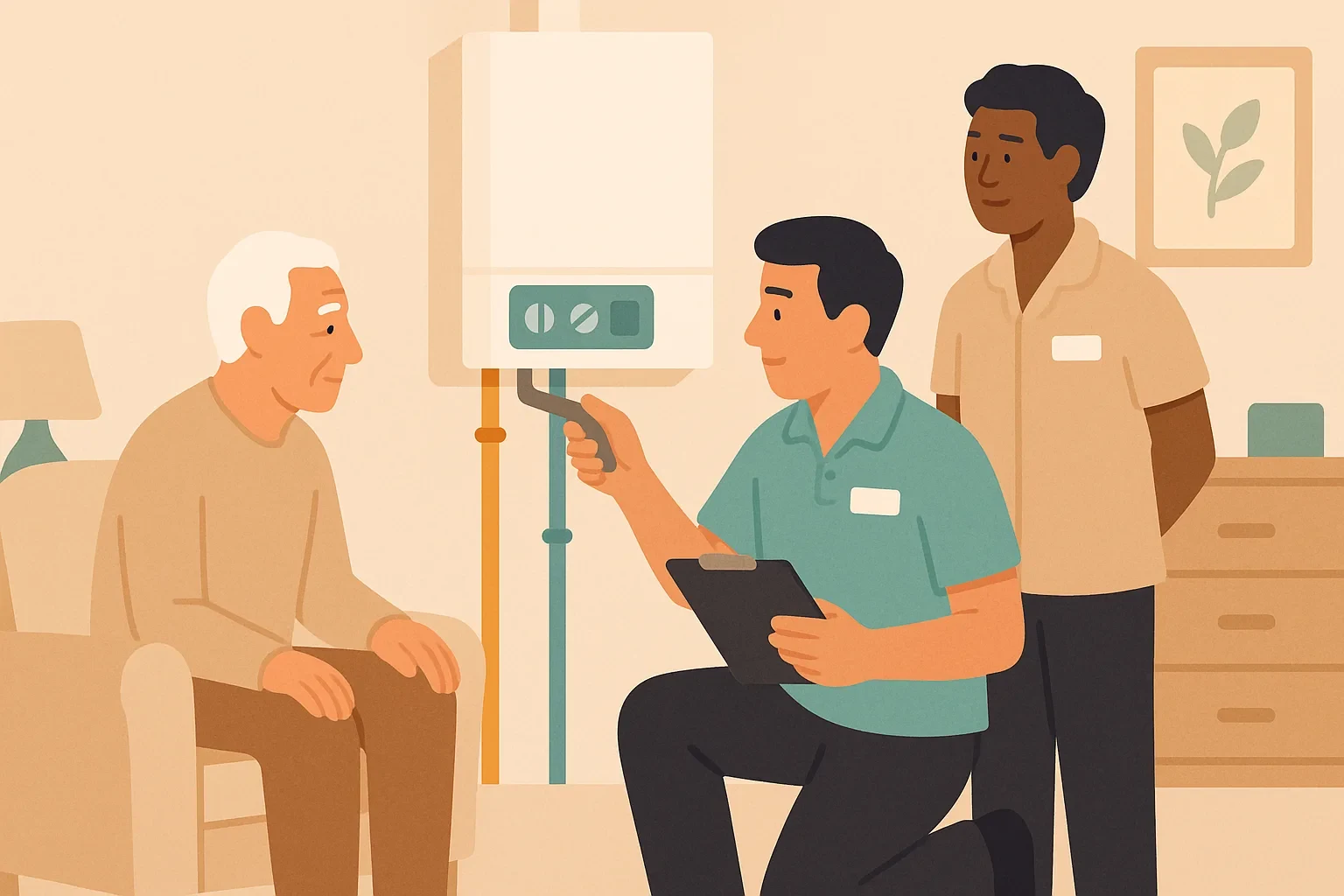
Fixed installation testing, PAT and safe use of electrical equipment.

The duty to manage asbestos: register, survey, and safe systems of work.

Selection, maintenance and statutory examination of equipment, including hoists and slings.

Keeping the premises safe, suitable and maintained under Regulation 15.


Right support, right care, right culture, and the Oliver McGowan training duty.

Control of substances hazardous to health: assessment, storage and safe use.

First aid arrangements, appointed persons and kit under the First-Aid Regulations 1981.

Risk assessing lone work, check-in and escalation, and what happens when a worker cannot be reached.

Whole-building and progressive-horizontal evacuation, PEEPs and assembly.

Hours, rest breaks, night work and opt-outs under the Working Time Regulations.

The conduct expected of every member of staff, on shift and online.

Meeting the statutory learning disability and autism training duty at the right tier per role.

Recognising exploitation risk in your workforce and supply chain, and how concerns are raised.

The Bribery Act 2010 applied to care: gifts, wills, loans and financial boundaries with residents.

The Prevent duty: recognising radicalisation risk and how referrals are made.

How the service communicates with people, families and professionals, including interpreters.

Promoting independence through goal-based reablement and therapy involvement.

How the service tracks the fundamental standards and prepares for inspection.

Anticipating and making adjustments for disabled people under the Equality Act 2010.

Identifying, recording and meeting communication needs under the Accessible Information Standard. Our trial policy: same personalisation, same human review, same updates.
No policies match that. Try a broader term, or take a pack above.