
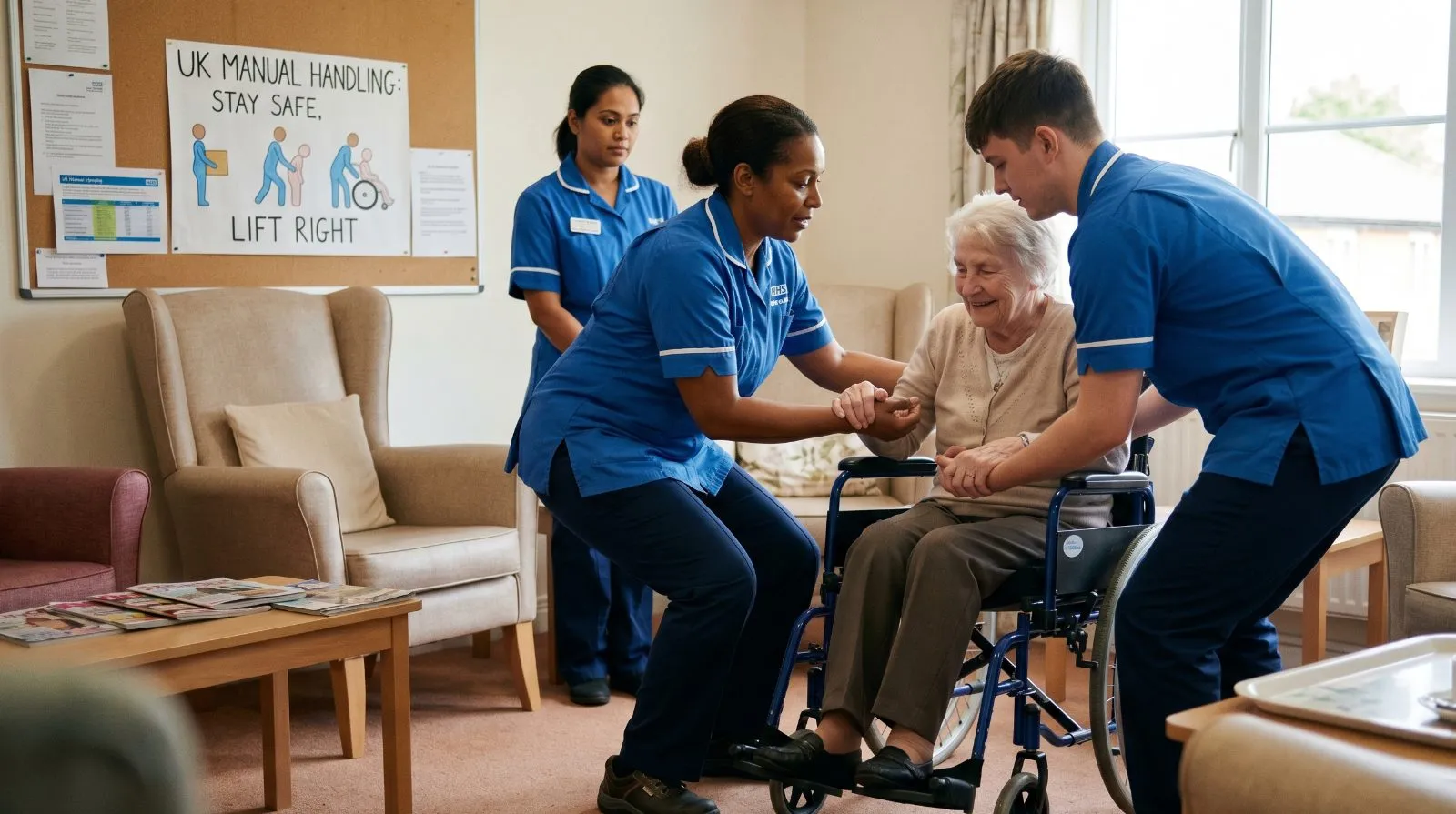
Every year, thousands of care workers in the UK sustain injuries that could have been prevented with proper training, and employers face legal consequences when they fail to meet their obligations.
A manual handling training course is not simply a box to tick for compliance: it is a legal requirement, a safeguard for your workforce, and a cornerstone of quality care delivery.
This guide is written for care home managers, domiciliary care providers, and healthcare employers who need to understand what the law demands, what good training looks like, and how to choose a course that genuinely protects staff and residents. We move beyond generic advice to address the specific challenges of care environments, where patient handling, confined spaces, and dignity considerations make manual handling uniquely complex.
Why Manual Handling Training Remains Critical in 2026
Manual handling injuries continue to dominate workplace injury statistics in the UK. The Health and Safety Executive reports that handling, lifting, and carrying account for a substantial proportion of all reported non-fatal injuries, with back injuries and musculoskeletal disorders remaining stubbornly persistent across the care sector. These are not minor strains: cumulative damage can end careers and leave care workers with chronic pain that follows them into retirement.
The Manual Handling Operations Regulations 1992 remain the legal backbone of employer duties, and in 2026, they are enforced as actively as ever.
The regulations require employers to avoid hazardous manual handling where reasonably practicable, assess the risks of any handling that cannot be avoided, and reduce those risks to the lowest level achievable.
Training is a mandatory element, but the HSE has consistently reinforced that it is only one component of a broader strategy. Mechanical aids, ergonomic workspace design, and robust risk assessment procedures must sit alongside training for a programme to be genuinely effective.
The shift toward online training has accelerated, making compliance more accessible for care providers with stretched budgets and shift-based staffing.
However, the quality gap between providers has widened. A generic warehouse lifting module will not prepare a care assistant for hoisting a resident from bed to chair, nor will it address the dignity and infection control considerations that define care work. For the care sector, manual handling training must be purpose-built, and employers must scrutinise course content for sector-specific relevance before enrolling their teams.
This is where CareStreamAI Manual Handling training aims to fill the gap. Keep reading and get all the details about how we have bridged this gap.
The Legal Framework: Your Duties Under UK Law
The Manual Handling Operations Regulations 1992
The regulations establish a clear hierarchy of control that every employer must follow. First, avoid hazardous manual handling operations wherever it is reasonably practicable to do so. If avoidance is impossible, conduct a suitable and sufficient risk assessment that examines the task, the load, the working environment, and the individual capabilities of the worker. Once risks are identified, reduce them as far as is reasonably practicable through equipment, procedural changes, or workplace redesign. Training is a legal requirement at this stage, but the HSE is unequivocal: training alone will not ensure safe manual handling. It must be supported by proper equipment, safe systems of work, and ongoing supervision.
Employers must also consider the specific needs of workers who may be at heightened risk, including pregnant employees, new starters, and those returning from injury. A generic approach to risk assessment that treats all staff as identical will not satisfy an inspector or a court.
Consequences of Non-Compliance in 2026
HSE enforcement activity has not softened. Prohibition notices, improvement notices, and prosecutions for breaches of the Manual Handling Operations Regulations continue to feature in HSE annual reports. Fines can be substantial, and in serious cases, custodial sentences for directors remain a possibility under the Health and Safety at Work Act 1974.
For care providers regulated by the Care Quality Commission, manual handling failures can trigger inspection findings of unsafe care. CQC inspectors will review training records, observe handling practices during site visits, and speak to staff about their confidence in using equipment. Inadequate manual handling arrangements can contribute to ratings downgrades and, in the worst cases, enforcement action against a provider's registration.
What to Look for in a Manual Handling Training Course
Accreditation and Certification Standards
Not all certificates are equal. When selecting a manual handling training course, look for third-party assurance from recognised bodies such as RoSPA or the CPD Certification Service. These accreditations indicate that the course content has been reviewed against established standards and that the provider's assessment methods are robust.
A valid certificate should display the course date, the provider's name and logo, the accreditation body's mark, and a unique identifier that can be verified.
Employers should check the recommended renewal period, which typically ranges from one to three years. Some providers issue certificates with no expiry date, but best practice and insurer expectations lean toward regular refresher training.
Be cautious of courses that award a certificate solely for passive video viewing, with no knowledge checks or practical assessment. A certificate earned without any demonstration of understanding offers false reassurance and will not withstand scrutiny during an inspection or legal claim.
Online vs. In-Person: The 2026 Landscape
Online manual handling training has matured significantly. For care providers managing large, shift-based teams, the flexibility of e-learning is hard to match. Staff can complete modules at times that suit rotas, progress at their own pace, and revisit material as needed. The cost per learner is typically lower than in-person training, and administrative overhead for booking and record-keeping is reduced.
The HSE has traditionally emphasised that training should include practical work so the trainer can identify anything the trainee is not doing safely. This has been a sticking point for purely online courses. The best online providers in 2026 address this gap through high-quality video demonstrations filmed in realistic care settings, interactive scenarios that require learners to identify unsafe practices, and structured follow-up mechanisms for any assessment questions that are answered incorrectly.
CareStreamAI's approach reflects this evolution. The platform delivers online training with structured follow-ups for questions not passed, ensuring that no staff member progresses without demonstrating understanding. This model bridges the gap between the scalability of e-learning and the verification that practical competence requires. For care providers seeking a comprehensive solution, the moving and handling of people course offers sector-specific content designed for real care environments.
Industry-Specific Content: Why Generic Courses Fall Short
A warehouse operative lifting pallets and a care assistant supporting a resident during a transfer face fundamentally different challenges. Generic manual handling courses focus on inanimate loads: boxes, sacks, and trolleys. They do not address hoist sling positioning, lateral transfers from bed to chair, or the unpredictable movements of a resident experiencing confusion or distress.
Care sector training must also cover dignity and respect. A resident should never feel like a load being moved. Communication before and during handling, preservation of privacy, and techniques that minimise the resident's discomfort are integral to competent care. Infection control during handling, particularly when using shared equipment like hoists and slide sheets, is another dimension absent from generic training.
The physical environment of care adds further complexity. Bedrooms, bathrooms, and narrow corridors present space constraints that a warehouse or office does not. Staff must learn to assess and adapt to these conditions, using equipment correctly in tight spaces and recognising when a two-person assist is necessary. A quality care-specific course uses scenarios drawn from real care settings, not stock footage of a warehouse floor.
How CareStream Differs from Generic Online Courses
CareStream training is built specifically for the care sector, not adapted from generic corporate e-learning that happens to mention care along the way. Every module in the standard library is grounded in best practice for UK adult social care and maps directly to the mandatory subjects a care service is expected to cover, from the Care Certificate, safeguarding adults and children, and moving and handling, through to medication administration, the Mental Capacity Act and DoLS, end-of-life care, pressure ulcer prevention, and recognising the deteriorating resident.
These are not abstract topics. They are the real responsibilities your staff carry every shift, written in the language of the care home and framed around the people you support. Each module teaches the subject, applies it to a genuine care scenario, and then assesses understanding, so staff learn how the knowledge plays out in practice rather than memorising facts for a test.
Because the modules are designed around the realities of care, they also reflect the way care services actually operate. The library recognises that different settings have different needs, with tailored modules for residential care, nursing homes, domiciliary and live-in care, complex care, hospices and more, so a community nurse and a care assistant in a dementia unit are not handed identical, one-size-fits-all content.
Modules also distinguish between the knowledge component and the practical, observed competencies that certain tasks demand, flagging clearly where a supervisor sign-off is still required for areas like medication, moving and handling, catheter care or buccal midazolam administration. And where your home or care setting has its own policies, CareStream can generate a complete module directly from those documents, so the training your staff complete reflects your procedures, your scenarios and your standards. The result is training that speaks your team's language, fits the daily reality of care delivery, and meets the regulatory expectations placed on the sector.
Training Question(s) Follow Up
The real power of CareStream training lies in what happens when a staff member gets something wrong. Rather than simply marking the answer incorrect and moving on, the system treats every wrong answer as a signal that a knowledge gap needs closing.
The moment a question is answered incorrectly, CareStream generates a short, policy-grounded micro-lesson that explains the right answer and why it matters, drawing on your home's own policies so the correction reflects how you actually work rather than generic advice. It then sends the staff member a fresh question on the same point, never a repeat of the one they missed, to confirm the learning has truly landed.
If needed, it keeps building targeted questions and learning around that topic until the staff member demonstrates genuine understanding. This means a single mistake becomes a focused, personalised piece of training delivered straight to the person who needs it, turning a moment of weakness into a moment of growth.
And because every step of this learn-and-retry loop is logged, you have clear evidence that the gap was actively closed and not just flagged, which is exactly the kind of proof CQC inspectors want to see.
Common Mistakes When Choosing or Completing Training
A recurring error is treating manual handling training as a one-off event. The HSE recommends refresher training at regular intervals, typically every one to three years, and whenever tasks, equipment, or the needs of those being supported change. A certificate earned three years ago offers little protection if the holder has not practised the skills or if new equipment has been introduced without updated training.
Price-driven selection is another pitfall. The cheapest course on the market may lack accreditation, use generic content irrelevant to care, or award a certificate without any meaningful assessment. The cost of a single back injury claim will dwarf any savings made on cut-price training. Employers should evaluate courses on accreditation, sector relevance, and assessment rigour, not headline price alone.
Tick-box compliance is perhaps the most dangerous mistake. If training is completed hurriedly, without engagement, and never reinforced by managers on the floor, knowledge degrades rapidly. Staff revert to old habits, and the training investment is wasted. The HSE's core message bears repeating: training alone is not enough. Without risk assessments, proper equipment, and a culture that prioritises safety, even the best course will fail to prevent injuries.
Finally, poor documentation leaves employers exposed. Training records must be complete, accessible, and up to date. They should show who was trained, on what date, by which provider, and when refresher training is due. During an HSE inspection or CQC visit, the inability to produce clear records can trigger a deeper investigation and findings of non-compliance, even if training was actually delivered.
How does CareStreamAI meet these demands?
CareStream meets the rigorous training demands of UK adult social care by moving beyond the traditional once-a-year compliance session and turning training into a continuous, structured programme delivered through online e-learning. At its core is a full library of teach-then-assess modules (including manual handling) covering every mandatory subject a care service needs, from safeguarding, fire safety and medication administration through to infection control, the Mental Capacity Act and end-of-life care, each grounded in best practice and built around the home's own policies. Managers can assign ready-made modules from the standard library or have CareStream generate a tailored module directly from their policy documents.
Every module follows the same disciplined structure. It teaches the topic in short sections, applies it to a realistic care scenario, and finishes with a full assessment. Staff complete their learning in the hub on their phone, by typing or speaking, in over 60 languages, or by email if they prefer, and every answer is recorded, giving managers a live compliance dashboard showing exactly who is current, in progress or overdue across the whole team.
What makes the approach genuinely rigorous, though, is what happens between renewal dates rather than just on them. Because research shows people forget the majority of new information within a day without reinforcement, CareStream keeps knowledge fresh throughout the year through spaced, ad-hoc knowledge checks, the ability for staff to ask training questions any time and get accurate, policy-grounded answers, and a learn-and-retry loop that turns a wrong answer into a short micro-lesson followed by a fresh question on the same point, so the gap is closed rather than merely logged.
Automatic renewal reminders go out at 90, 30 and 7 days before each due date, with a renewal digest for managers, removing the need for spreadsheets and manual chasing. The result is a complete, year-round audit trail covering individual question answers, ongoing knowledge checks, external specialist sign-offs and reminder delivery, giving CQC inspectors far stronger evidence of maintained competence than a single completion certificate ever could.
Conclusion
In a sector where a completion certificate from eleven months ago no longer reassures anyone, CareStream gives you something far more valuable: confidence that your team's knowledge is genuinely current, every day of the year. It takes the burden of compliance off your shoulders, replacing spreadsheets and last-minute chasing with a single hub that teaches, tests, reinforces and records, all in your staff's own language and built around your own policies.
Whether you look after a team of ten or two hundred, you will always know exactly where everyone stands, and you will walk into any CQC inspection with the evidence to prove it. Turn compliance training into a year-round conversation and see the difference for your home.
Book a demo today, start your free trial, and give your staff training that actually sticks.
Frequently asked questions
Len Burgess
Senior Care Advisor
Len Burgess has worked in the care sector for over 8 years, with hands-on experience across residential, nursing and community settings. Having supported teams through CQC inspections and the day-to-day reality of keeping a service compliant, he writes about regulation, quality and best practice in a way that's grounded in what actually happens on the floor, not just what the guidance says.