For anyone running a care home, a nursing home, or a home care agency in England, a few moments carry more weight than the day a Care Quality Commission (CQC) inspector walks through the door. It is the day your everyday practice is observed, your records are read, and your team is asked to explain how they keep people safe and well.
This guide explains what a CQC inspection day actually is, what it means for your service, how it works from start to finish, and how it applies to you, all in plain language.
What is the CQC inspection day?
CQC inspection day is the on-site part of a CQC assessment, when one or more inspectors visit your service to see how care is delivered in real life. The CQC is the independent regulator of health and adult social care in England, and inspection is how it checks whether a service meets the fundamental standards of quality and safety.
It is worth clearing up a common misunderstanding. Under the current approach, the visit is not a single, standalone event that decides everything on its own. The CQC gathers evidence about your service on a continuous basis, both off-site and on-site, and the inspection day is the part where inspectors come to observe, talk to people, and review records in person. The visit then feeds into your overall assessment and rating.
In short, inspection day is the moment the regulator sees your service as it really is, on an ordinary day, with ordinary pressures. That is exactly why it matters so much.
What inspection day mean for your service
The stakes are high because the outcome is public and lasting. Your rating is published on the CQC website, you must display it, and families, commissioners and prospective staff all read it. A strong result supports your reputation, your occupancy and your recruitment. A poor one can do real damage.
A few realities shape what inspection day means in 2026.
First, it is often a surprise. Inspections of care homes and nursing homes are frequently unannounced, with an inspector simply arriving at the door so they can see the service running normally. Home care and domiciliary agencies usually get only short notice, often around 48 hours, so that staff who are out visiting clients can be available. Either way, you cannot rely on a long run-up to get ready.
Second, inspections are happening. The CQC is still actively assessing providers and has been recruiting more inspectors to clear a backlog, working toward a large number of assessments through 2026. Many services are carrying ratings that are years out of date, which means your turn could come at any time.
Third, the day rewards consistency, not performance. Because so much evidence is gathered continuously and because the visit is unannounced, you cannot stage a perfect day. What inspectors see is your normal. The services that do well are the ones where good practice is simply how things are done, every shift.
That is the real meaning of inspection day. It is less a test you cram for and more a snapshot of habits you have already built.
How the CQC inspection day works
Although every visit is slightly different, the day usually follows a recognisable journey. Here is how it typically unfolds.
1. Arrival and introductions
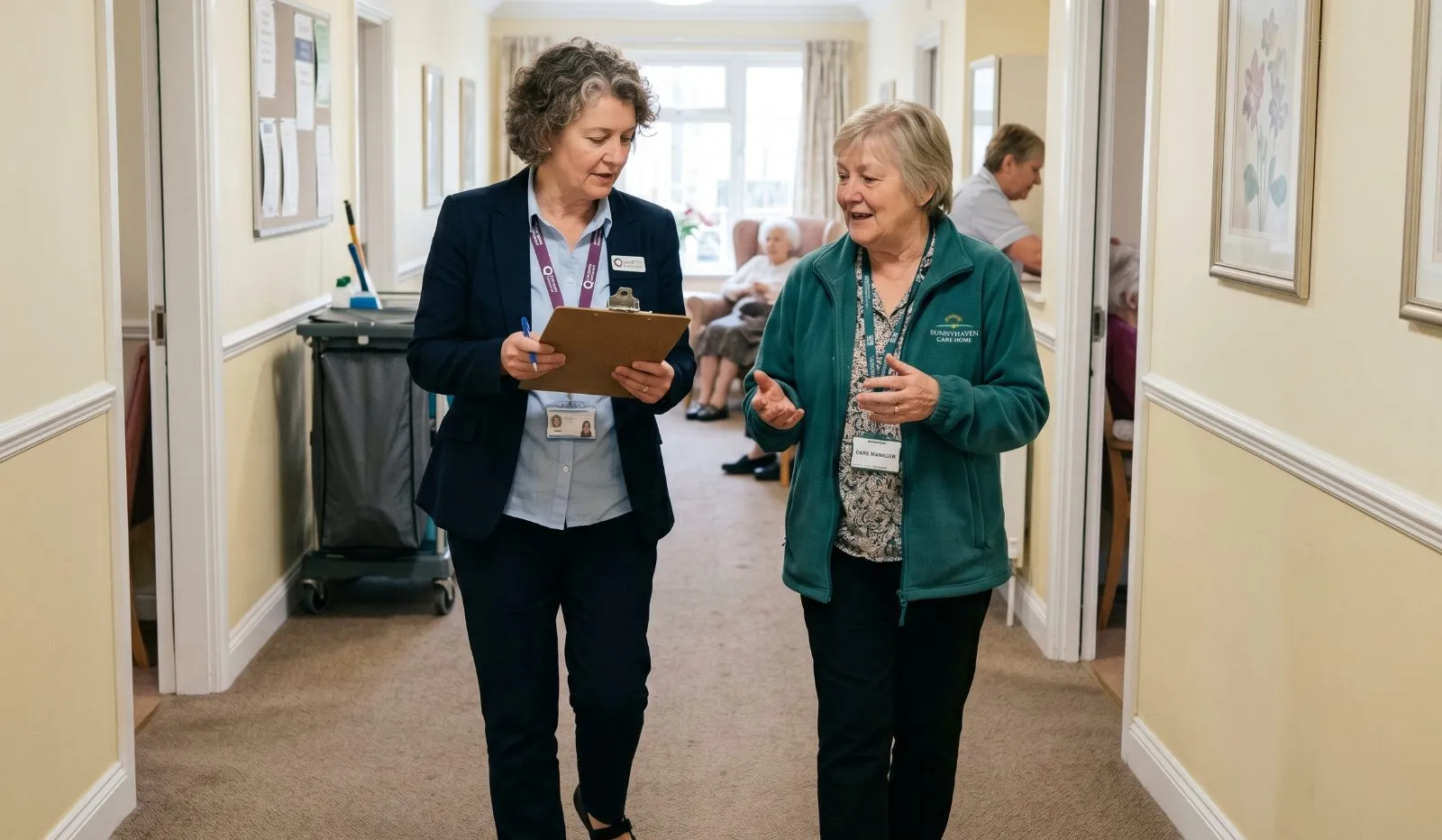
Inspectors arrive, show identification, and ask to speak with the person in charge. If your registered manager is out, the most senior person present should know what to do, including how to contact the manager. The tone is professional rather than adversarial. Inspectors are there to find out how care works, not to catch you out for its own sake.
2. An opening conversation
There is usually a short discussion about the service, recent changes, any incidents, and how you monitor quality. This is an early chance to show that leadership is open, honest and on top of the detail.
3. Observing care
Much of the day is spent watching care happen. Inspectors notice how staff speak to people, whether dignity and choice are respected, how call bells are answered, how mealtimes run, and whether the environment is clean, safe and comfortable. In-home care observation may include accompanying staff or reviewing how visits are planned and delivered.
4. Talking to people
Inspectors speak with the people who use your service, with families and visitors, and with staff at all levels. They want to hear directly about experiences, and they want to know whether staff understand their roles, feel supported, and can explain their practice with confidence.
5. Reviewing records and evidence
Inspectors examine care plans, risk assessments, medicines records, incident and accident logs, safeguarding records, training records and governance documents. Medication records, incident logs, competency checks and safeguarding responses are some of the most closely scrutinised areas, because they show whether safe, well-led care is real and documented.
6. Feedback at the end
Before leaving, inspectors usually give initial verbal feedback to senior managers, flagging strengths and any concerns. If something urgent is found, they will say so and explain what must happen.
7. The draft report and rating
After the visit, the CQC normally sends a draft report within around ten working days. You then have roughly ten working days to check it for factual accuracy before it is finalised and published with your rating. The assessment is organised around the five key questions, and each is judged using a four-point rating scale.
The five key questions behind the day
Everything inspectors do on the day maps back to five questions:
- Safe. Are people protected from abuse and avoidable harm?
- Effective. Does care achieve good outcomes based on the best available evidence?
- Caring. Do staff treat people with compassion, kindness and respect?
- Responsive. Is care organised around each person's individual needs and wishes?
- Well led. Do leadership, culture and governance support high-quality care?
The four ratings that result are Outstanding, Good, Requires Improvement and Inadequate.
How inspection day applies to you
The shape of the day shifts depending on the kind of service you run.
For care homes, expect a strong focus on Safe and Effective, since these areas attract the most enforcement. Inspectors will look closely at safeguarding, medicines management, falls and pressure care, staffing levels and skill mix, and how clearly your governance turns risks into completed actions. Because visits are frequently unannounced, what matters is that an ordinary day stands up to scrutiny.
For nursing homes, all of the above applies, with extra weight on clinical effectiveness. Inspectors will test whether nursing care follows current evidence, whether clinical records are accurate and timely, and whether outcomes such as wound healing, nutrition and hydration are monitored and acted upon.
For home care and domiciliary agencies, much of the evidence sits away from a single building, so the day leans heavily on care records, visit planning and call monitoring, incident reporting, and feedback from clients and families. The short notice you typically receive makes standing readiness essential because there is little time to prepare once the call comes.
For every type of service, the most useful preparation is to know that your team can answer the question an inspector will keep asking in different forms: how do you know this is safe, and how can you show it? If your staff can explain their practice confidently and point to the evidence behind it, you are in a strong position whichever inspector arrives.
The five questions everyone asks about inspection day
These are among the most searched questions about CQC inspections. Here are clear answers.
1. What triggers a CQC inspection?
Inspections are prompted by a mix of factors rather than a single cause. Recent care home reports describe assessments triggered by concerns or complaints, feedback from people and families, information that providers are legally required to notify, the age of the previous rating, whistleblowing, and wider intelligence and data trends. A significant change, such as a new owner or a new registered manager, can also prompt a visit. In other words, both routine timing and specific risk signals can bring inspectors to your door.
2. What do CQC inspectors look for?
Inspectors look for evidence that care is safe, effective, caring, responsive and well-led, and they gather it by observing care, speaking to people, families and staff, and reviewing records. In practice, that means clean and safe environments, respectful and person-focused interactions, accurate care plans and risk assessments, secure and up-to-date medicines records, prompt and thorough safeguarding, strong incident reporting, and clear governance where issues are spotted and acted upon. Staff being able to explain their own practice confidently carries real weight.
3. How many days does a CQC inspection take?
It depends on the size and complexity of the service. For many smaller services, the on-site visit is completed in a single day, while larger or more complex services may be visited over two or more days, sometimes by a small team of inspectors. Remember that the on-site day is only part of the picture, because the CQC also gathers evidence off site before and after the visit as part of a continuous assessment.
4. What happens if you fail a CQC inspection?
A poor outcome leads to a structured escalation rather than instant closure. If a service is rated Inadequate overall, it goes straight into special measures. If it is rated Inadequate in just one of the five key questions, the CQC will reinspect within six months. Requires Improvement ratings typically allow six to twelve months before reinspection, with documented evidence of progress expected. Alongside ratings, the CQC can require action plans, issue warning notices, place conditions on your registration, and, in the most serious cases, cancel registration so the service can no longer operate. Where there is an immediate risk to life or safety, urgent powers allow the CQC to act without the usual steps. The clear message is that there is usually time and support to improve, but the consequences of inaction are severe.
5. Are CQC still doing inspections?
Yes. The CQC is continuing to assess and inspect services across England, and has been recruiting additional inspectors to increase the number of assessments it completes through 2026. While the regulator is also reshaping its frameworks behind the scenes, this does not pause inspections. With many ratings out of date and assessment numbers rising, the practical takeaway is that an inspection could happen at any time, so continuous readiness is the only safe approach.
How CareStream helps you be ready on the day
This is where CareStream is designed to help. CareStream AI is a platform built for UK care providers that turns your own library of policies and procedures into an always available, intelligent assistant. Instead of staff hunting through binders, shared drives or out-of-date handbooks, CareStream takes in your home's actual documents and makes them instantly searchable and answerable in plain English, by web chat and by email. Every answer is grounded in your own policies and traceable back to the source document, so managers stay in control of what the policy really says while teams get reliable guidance the moment they need it.
Because care teams in the UK are wonderfully diverse, CareStream also lets a staff member ask a question in their own language, including Polish, Romanian, Tagalog, Portuguese and many more. It detects the language automatically, finds the right policy, and answers in that same language while still pointing to the source. That removes a real barrier to confidence on inspection day, because a procedure only helps if the person on shift actually understands it.
Around this sit the tools that build everyday readiness. CQC staff questions let managers create a bank of inspection-style questions, send them out by each person's preferred channel, and track who has responded and how well, so you know where your team is confident and where they need a refresher before an inspector ever arrives. Training lets managers create and assign modules drawn from their own policies, auto-generate questions and answers, lock approved versions, and watch a live compliance grid showing who has completed what, with automated delivery rules and post-incident sends built in. New staff onboarding turns this into structured, auditable flows for each role from day one. Audits provide templated, repeatable checks that capture evidence and surface issues early rather than on the day itself.
CareStream then pulls all of this signal together into its CQC Report and supporting gap analysis. By looking at the questions staff are actually asking, including the ones the policy library could not answer, the regulations your policies do and do not cover, your training compliance, and your audit results, it produces a coverage score and an inspection readiness picture mapped to the CQC framework. The result is that your service is not just storing policies, it is continuously demonstrating that those policies are understood, trained, followed and evidenced, turning compliance from a once a year scramble into something your whole team lives every day.
The bottom line
CQC inspection day is the moment your everyday care is seen for what it truly is. In a year where visits are often unannounced and assessment numbers are rising, you cannot rely on a last-minute scramble. Build good practice into every shift, make sure your team can explain and evidence what they do, and inspection day becomes far less daunting. The services that treat readiness as a daily habit are the ones that open the door with confidence.
This article is for general guidance and reflects the position in 2026 while the CQC's frameworks continue to evolve. Always check the latest guidance on the CQC website for your specific service type.
Frequently asked questions
Len Burgess
Senior Care Advisor
Len Burgess has worked in the care sector for over 8 years, with hands-on experience across residential, nursing and community settings. Having supported teams through CQC inspections and the day-to-day reality of keeping a service compliant, he writes about regulation, quality and best practice in a way that's grounded in what actually happens on the floor, not just what the guidance says.